SEO Isn’t Dead—but the CMO Now Needs an AEO/GEO Strategy
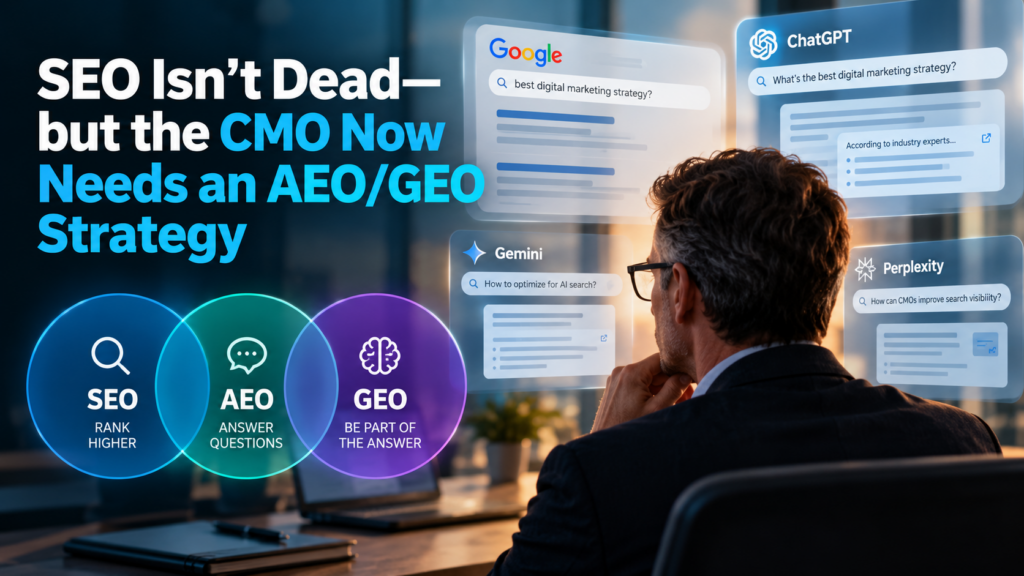
SEO Isn’t Dead—But the CMO Now Needs an AEO/GEO Strategy
Every few years, someone declares SEO dead.
Social media was supposed to kill it. Paid search was supposed to make it irrelevant. Voice search was going to replace it. Now AI is supposedly delivering the final blow.
SEO isn’t dead. But the way people find information is changing fast, and the CMO’s search strategy has to change with it. Traditional search engine optimization still matters, but it can’t operate alone anymore. Marketing leaders now need Answer Engine Optimization (AEO) and Generative Engine Optimization (GEO) working alongside it.
The old question was: How do we rank on Google?
The better question is: How do we make our brand discoverable, understandable, credible and quotable wherever customers are asking questions?
That’s a much bigger marketing challenge, and a much bigger opportunity.
Search Is Becoming an Answer Ecosystem
For two decades, search followed a predictable script. A customer had a question, opened Google, typed a query and clicked one of ten blue links. The marketer’s job was clear: rank as high as possible.
AI is rewriting that script. Customers can now ask detailed questions and get a synthesized answer instead of a list of websites. Google’s AI results, ChatGPT, Gemini, Perplexity and other AI-powered tools are changing the interface between people and information.
That means brands aren’t only competing for rankings anymore. They’re competing for inclusion in the answer.
Your website still matters. Your content still matters. Your authority still matters. But the definition of visibility just got a lot wider.
SEO vs. AEO vs. GEO: What’s the Difference?
The three disciplines overlap, but each has a different job. Here’s how I’d explain them to a leadership team.
| SEO | AEO | GEO | |
|---|---|---|---|
| Core question | How do we rank? | Have we given the clearest answer? | How is our brand represented in AI answers? |
| Optimizes for | Search engine results pages | Direct answers and featured responses | AI-generated, multi-source answers |
| Key tactics | Keywords, technical SEO, links, site architecture | Question-based headings, FAQs, concise definitions, structured data | Original research, expert visibility, consistent third-party presence |
| Success looks like | Rankings and organic traffic | Being the answer that gets pulled | Being cited, mentioned or recommended |
SEO: The Foundation
Traditional SEO improves a website’s visibility in search results. It covers keyword research, technical SEO, site architecture, internal linking, backlinks, page speed, search intent, content quality, local SEO and structured data.
It’s still the foundation. If your site is technically weak, your content lacks authority or search engines can’t understand your pages, an AI strategy won’t fix it.
AEO: Be the Clearest Answer
AEO structures information so platforms can easily find direct answers to real questions. Instead of only asking “What keyword should this page rank for?” you also ask “What is the customer asking, and have we answered it better than anyone else?”
AEO rewards content that is direct, structured and useful: question-based headings, concise definitions, FAQ sections, step-by-step explanations, comparison tables, statistics, schema markup and clear topical organization. The goal is to make your expertise easy for machines, and people, to understand.
GEO: Shape How AI Represents You
GEO goes a step further. It focuses on how your company, executives, products and expertise show up inside AI-generated answers. Generative systems often synthesize many sources before responding, so you’re not optimizing for a single blue link.
You’re building an information footprint that makes your organization more likely to be recognized as a credible source across the whole ecosystem.
Think Beyond Traffic: Measure Share of Answer
This may be the biggest mindset shift for marketing leaders.
We’ve measured organic search by traffic for years. More rankings meant more clicks, more clicks meant more sessions, and more sessions (hopefully) meant more leads and revenue. But what happens when someone gets their answer without ever visiting your site?
That doesn’t mean the interaction had no value. If an AI platform cites your company, recommends your product or pulls from your research, your brand may have shaped the buying decision without generating a single click.
That’s why CMOs need to track share of answer alongside share of search. Start by asking:
- How often does our brand appear in AI-generated answers to our most important questions?
- Which competitors show up more often than we do?
- Which sources are AI platforms citing?
- What topics does AI associate with our brand?
- Are our executives recognized as authorities in their fields?
- Are AI systems describing our products and services accurately?
- Are those appearances driving branded search, leads and revenue?
The marketing dashboard of the future can’t stop at rankings and organic sessions.
Rethink Your Content Strategy
The rise of AI doesn’t mean you should start publishing hundreds of AI-generated articles. I’d argue the opposite.
As AI makes generic information nearly free to produce, original expertise becomes the scarce asset. Invest in what competitors can’t easily copy:
- Original research. Run surveys, analyze proprietary data and publish what you find.
- First-party data. Turn internal trends and anonymized customer insights into market intelligence.
- Executive and team expertise. Your executives, technicians, consultants and salespeople hold enormous knowledge. Capture it.
- Case studies. Don’t just claim your solution works. Show how it solved a specific problem.
- A point of view. Your organization should have opinions earned through experience.
A thousand websites can explain what PPC is. Far fewer can explain what happened after managing millions of dollars in PPC across multiple markets. Experience is the differentiator.
Build Around Questions, Not Just Keywords
Keyword research isn’t going away, but it should be paired with question research. Map the full conversation a customer has before buying.
Take an HVAC company. Traditional SEO might target “AC repair Long Island.” That’s still valuable. But a homeowner might ask an AI assistant:
“My central air conditioner is 14 years old and needs a $2,000 repair. Should I repair it or replace it?”
That’s a far richer query, and exactly the kind of question brands should be answering. Build content around the questions buyers actually ask: what, why, when, how, which, should I, what’s the difference between, how much, is it worth it and what should I look for.
In effect, you’re building a knowledge base around your customer’s buying journey.
Authority Will Matter More, Not Less
One consequence of generative AI is that brand authority becomes even more valuable. When thousands of sites publish nearly identical content, trustworthy sources stand out.
That means SEO can no longer belong to the SEO team alone. Search, answer and generative visibility now intersect with:
- Public relations: earned media reinforces organizational authority.
- Thought leadership: executives should consistently publish useful perspectives in their areas of expertise.
- Social media: your broader footprint signals what the brand stands for and talks about.
- Reviews and reputation: third-party signals shape how customers, and machines, understand you.
- Digital PR and backlinks: mentions from reputable publications and industry groups still carry weight.
- Brand marketing: people search for companies they already recognize.
The brands best positioned to win in AI discovery will be the ones that build a consistent web of authoritative information around themselves.
Don’t Neglect the Technical Foundation
CMOs don’t need to become technical SEO specialists. But they do need teams that maintain the infrastructure that lets search engines and AI systems understand their content: crawlability, indexability, site performance, mobile usability, canonicalization, XML sitemaps, schema markup, logical site architecture, internal linking, clear authorship, fresh content and accessible page structure.
Content strategy and technical strategy have to work together.
The New Search Strategy Is a Brand Strategy
This is where the conversation gets interesting for CMOs. SEO used to feel like a channel. GEO makes it look a lot more like brand infrastructure.
Think about everything an AI system might encounter when trying to understand your organization: your website, executive profiles, news coverage, customer reviews, industry publications, research, social content, videos, podcasts, directories, case studies and third-party references.
Together, those signals form a digital understanding of your company. Marketing teams need to be far more deliberate about what that ecosystem says.
A Practical SEO + AEO + GEO Framework
Here’s how I’d structure the strategy:
- Protect the SEO foundation. Keep investing in technical SEO, keyword strategy, site architecture, backlinks and high-quality content. Don’t abandon what already works.
- Build an answer architecture. Identify the major questions customers ask across the buying journey, create authoritative resources that answer them and organize those answers logically across your site.
- Create information worth citing. Publish original research, expert commentary, proprietary data, case studies and in-depth educational resources. Give search and AI platforms something valuable to reference.
- Expand brand authority. Coordinate SEO with PR, social, executive thought leadership, reviews, video, partnerships and industry publications. Search visibility isn’t a website-only problem.
- Measure AI visibility. Pick 25, 50 or 100 strategically important customer questions. Test them regularly across major AI platforms, record which brands appear and track whether your visibility improves over time.
The Bottom Line
SEO isn’t dead. It has grown up. The brands that win the next era of discovery will pair a strong SEO foundation with content built to answer real questions and an authority footprint that AI systems trust.
None of this has to be perfect on day one. What matters is building the discipline now, while your competitors are still debating whether SEO is dead.
How is your team approaching AI visibility? I’d like to hear what’s working for you. Connect with me on LinkedIn or leave a comment below.