I’m a CMO. Here’s How AI Actually Fits Into My Marketing Organization
There is no shortage of conversation about artificial intelligence in marketing.
Depending on who you listen to, AI is either going to replace the marketing department, eliminate agencies, produce every piece of creative, make decisions for the CMO, or completely transform marketing overnight. That isn’t how I see it. As a CMO, I’m far more interested in what AI can actually do for my marketing organization today. For me, AI isn’t the strategy. It’s becoming part of the infrastructure that allows my team and me to execute the strategy faster, analyze more information, reduce repetitive work, and make better-informed decisions.
My approach is simple:
Use AI to make marketers better at marketing—not to remove marketers from marketing. Here’s what that looks like inside my organization.
My AI Marketing Stack
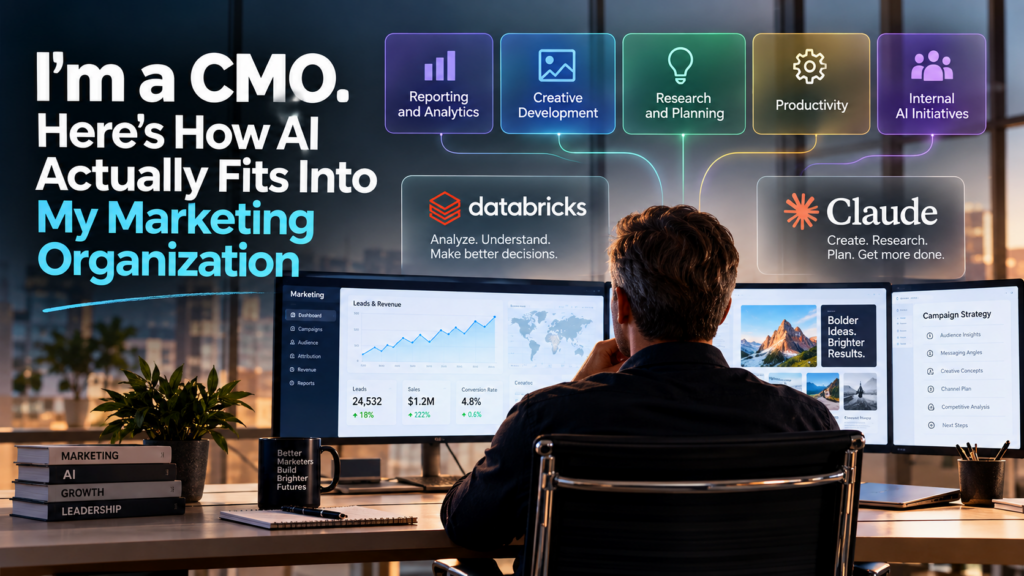
I don’t believe in using AI simply because a tool has an AI label attached to it. Every technology in my marketing stack needs a purpose. Today, my use of AI generally falls into five areas:
- Reporting and analytics
- Creative development
- Research and planning
- Productivity
- Internal automation and AI initiatives
Some of the tools I currently use include Databricks for analyzing sales and lead data, Claude for creative development, organization, research and productivity, and internally developed AI solutions designed around our company’s specific needs.
What interests me most isn’t any individual platform.
It’s what happens when you begin connecting AI to the marketing workflow.
1. Reporting and Analytics: Turning Data Into Decisions
One of the biggest opportunities I see for AI is not content creation.
It’s data.
Marketing organizations generate enormous amounts of information: leads, sales, calls, website traffic, advertising performance, CRM activity, customer behavior, attribution data, affiliate performance, and more. The problem isn’t getting data. The problem is turning all of that data into something a marketing leader can actually use. I currently use Databricks to help analyze sales and lead data and produce daily and weekly reporting around lead sources and affiliate sources. Instead of simply asking, “How many leads did we generate?” I want to understand:
What happened? Why did it happen? And what should we do next?
That means looking beyond surface-level metrics. If leads increase, I want to know where they came from. If sales decline, I want to understand whether the issue is marketing, lead quality, geography, seasonality, sales conversion or something else entirely. If one affiliate or advertising source suddenly improves, I want to identify the change quickly enough to capitalize on it. AI can help marketers move from reporting the past to interpreting the past—and eventually predicting what might happen next.
That’s a much more valuable use of AI than simply generating another dashboard.
2. Creative Development: AI as a Creative Accelerator
Creative development is probably the area most people immediately associate with generative AI.
And yes, I use it.
But I don’t view AI as my creative director.
I view it as a creative accelerator.
For example, I use Claude and Claude Design to help develop concepts and creative for both organic and paid social media.
AI can help take an initial idea and quickly explore multiple directions.
A single campaign concept can become different headlines, messaging angles, social posts, ad concepts, calls to action and visual directions.
That dramatically changes the speed at which a marketing team can experiment.
Instead of spending hours developing one concept, marketers can spend that time evaluating ten.
The important distinction is that speed isn’t the same thing as quality.
A human still needs to determine whether the creative represents the brand, whether the offer makes sense, whether the message resonates with the audience and whether the campaign supports the larger business strategy.
AI creates possibilities.
Marketers decide which possibilities are worth pursuing.
3. Research and Planning: The World’s Fastest Starting Point
Another area where AI has become extremely useful for me is research.
Marketing leaders spend a surprising amount of time gathering information.
We research competitors.
We evaluate markets.
We review campaign performance.
We investigate new platforms.
We analyze customer behavior.
We develop presentations.
We prepare for meetings.
We build marketing plans.
AI can dramatically shorten the distance between a question and a useful starting point.
If I’m evaluating a new campaign, for example, AI can help me develop initial audience segments, identify potential objections, explore messaging strategies, organize competitive information and develop questions that my team should investigate further.
The key word is starting point.
AI output shouldn’t automatically become strategy.
It should help you get to strategy faster.
There is still a major difference between information and insight.
The CMO’s responsibility is turning one into the other.
4. Productivity: Giving Time Back to Marketers
This may ultimately be one of AI’s biggest contributions to marketing organizations.
Time.
Like most executives, a significant portion of my day can disappear into meetings, email, reporting, documentation and administrative work.
I use Claude to help organize information around my inbox, meetings and other daily responsibilities.
That doesn’t sound as exciting as generating an entire advertising campaign with AI.
But the cumulative impact can be enormous.
If AI saves a marketing executive 30 minutes a day, that’s roughly 125 hours over a typical 250-day working year.
Give those hours back to your team and suddenly they have more time for strategy, customers, experimentation, creative thinking and solving problems.
I don’t want my best marketers spending their days copying information between systems or manually summarizing reports.
I want them thinking.
AI can help create that space.
5. Building AI Around the Business
I’m particularly interested in what happens when companies move beyond public AI tools and begin building AI capabilities around their own workflows and data.
We currently have an internal AI team working on several marketing-inspired initiatives that I am helping oversee.
This is where I believe the next stage becomes particularly interesting.
Instead of asking:
“What can ChatGPT, Claude or another AI platform do?”
Organizations can start asking:
“Where are the bottlenecks inside our company, and can AI help solve them?”
That changes the conversation.
Maybe it’s identifying patterns in lead quality.
Maybe it’s automating portions of reporting.
Maybe it’s surfacing customer insights.
Maybe it’s helping sales and marketing teams understand which opportunities deserve attention.
Maybe it’s analyzing thousands of customer interactions to identify emerging issues.
The most valuable AI applications may ultimately be the ones customers never see.
Where Humans Remain Essential
For all my enthusiasm about AI, there are areas where I believe humans remain absolutely essential.
Strategy. Judgment. Empathy. Leadership. Creativity. Accountability.
AI can analyze performance.
A CMO still needs to decide whether the company should change direction.
AI can generate an advertisement.
A marketer still needs to understand whether that advertisement feels right for the brand.
AI can identify patterns in customer data.
A human still needs to understand the people behind those patterns.
And AI can recommend an action.
A leader still needs to take responsibility for the decision.
That’s an important distinction.
The danger isn’t that marketers won’t use enough AI.
The danger is that organizations will confuse automation with intelligence and output with strategy.
AI can produce enormous amounts of content and analysis.
That doesn’t mean any of it is good.
The CMO’s Role Is Changing
I believe the modern CMO increasingly needs to understand three worlds:
Marketing. Technology. Data.
AI sits directly at the intersection of all three.
That doesn’t mean CMOs need to become machine-learning engineers.
But we do need to understand what’s possible.
We need to ask better questions.
We need to understand our data.
We need to recognize where automation creates efficiency and where human involvement creates value.
And perhaps most importantly, we need to create organizations where marketers aren’t afraid of AI.
I don’t want my team competing against artificial intelligence.
I want them learning how to work with it.
AI Isn’t My Marketing Strategy
When people ask how I’m using AI in marketing, my answer continues to evolve.
Today, I’m using tools like Databricks for reporting and analysis, Claude for creative development, research and productivity, and working with our internal AI team on marketing-related initiatives.
Tomorrow, that stack will probably look different.
And that’s okay.
The individual platforms aren’t the strategy.
The objective is to build a marketing organization capable of learning faster, testing faster, understanding customers better and making smarter decisions.
AI can help us do all of those things.
But there is one principle I don’t expect to change:
AI should amplify the marketer—not replace the thinking that makes great marketing possible.
That’s how AI fits into my marketing organization today.
And I believe we’re still at the very beginning of figuring out what it can become.