Home Services Marketing Is a Trust Business, Not a Clicks Business
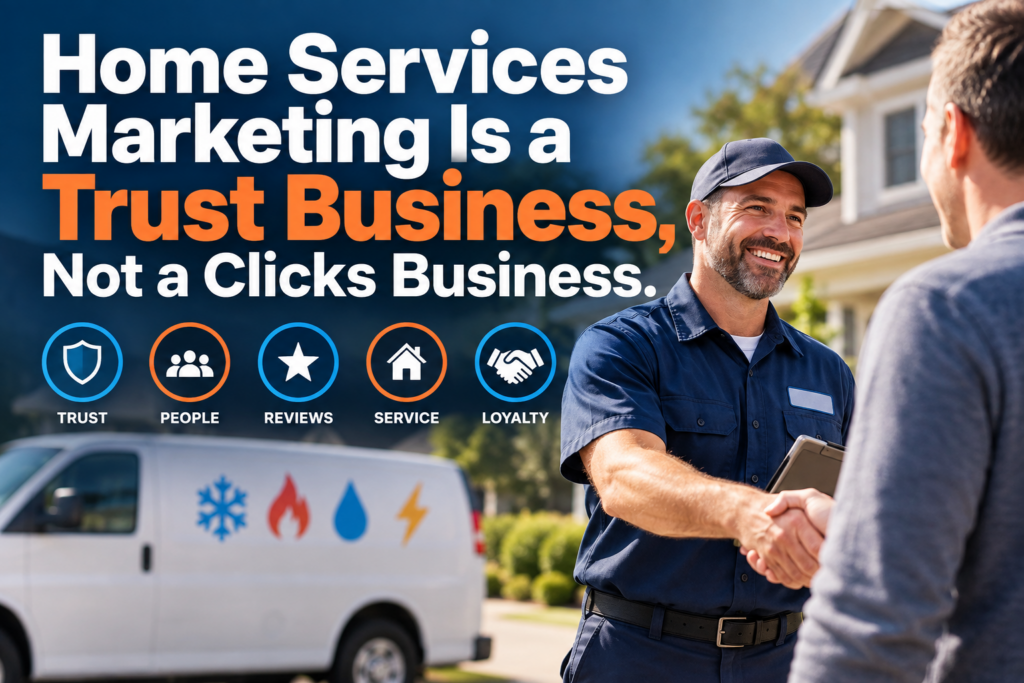
Why the most important metric in home services never appears in an attribution report
Every month I review a dashboard full of numbers: cost per click, cost per lead, conversion rate, CAC, ROAS, booked-job rate, revenue by source. I take those numbers seriously, and my teams know it. If you lead marketing and can’t explain your unit economics, you won’t keep the seat for long.
After 20 years in marketing leadership, much of it in PE-backed and multi-location home services businesses, I’ve come to believe something many dashboards hide: we aren’t in the clicks business. We’re in the trust business.
A homeowner doesn’t invite a click into their house. They invite a person. A CMO who loses sight of that ends up optimizing the wrong things very efficiently.
Read more: Home Services Marketing Is a Trust Business, Not a Clicks BusinessThe Lead Count Trap
One of the most common mistakes I see, in boardrooms and in marketing departments, is treating lead volume as the scoreboard. A campaign produces 500 leads and everyone celebrates.
The executive questions come after that. How many of those leads picked up the phone? How many booked? How many appointments actually ran? How many estimates were presented, and how many closed? What was the average ticket? How many of those customers came back?
The question that matters most is usually the one nobody asks: why did the customer choose us?
Home services isn’t e-commerce. If someone buys the wrong $30 product online, it’s a minor annoyance. A $15,000 HVAC replacement is different. So is letting a plumber in during an emergency, or trusting an electrician with the system that protects your family. These aren’t transactions. They’re trust decisions, and our go-to-market strategy has to reflect that.
Attribution Is Not Influence
Attribution reports make the customer journey look simple. A homeowner searches Google, clicks an ad, fills out a form, and Google Ads gets the credit.
That’s rarely the whole story.
Before that click, the homeowner may have seen your trucks around the neighborhood. They may have gotten your direct mail, heard your radio spot, seen your name at a Little League field, or gotten a recommendation from a neighbor. They may have read your reviews six months earlier. Then the furnace dies. They search, and they recognize your name.
Paid search captured that demand. Your brand created it.
When I sit with a CEO or an operating partner to discuss budget, this is the distinction I push hardest on. Cutting “unattributable” brand spend often looks smart for a quarter. Then lower-funnel efficiency quietly erodes, CPLs creep up, and nobody can explain why. Attribution tells you where the customer arrived. It doesn’t tell you why they came.
Reviews Are a Growth Asset, Not a Reputation Chore
Too many organizations treat Google reviews as a customer-service matter. I treat them as one of the highest-leverage marketing assets we have.
Put two HVAC companies side by side in search results with similar star ratings. One has 47 reviews. The other has 2,700. Which one feels safer?
Homeowners use reviews to reduce risk. They aren’t just asking whether you can fix an air conditioner. They’re asking whether you’ll show up on time, respect their home, charge a fair price, and answer the phone if something goes wrong. Thousands of positive experiences create something no ad budget can buy: proof.
That’s why review generation belongs in the marketing plan, with targets, ownership, and executive visibility.
Your Technicians Are Your Most Important Media Channel
Here’s a point that makes some org charts uncomfortable: technicians are part of the marketing organization, even though they don’t report to me.
Marketing doesn’t end when the appointment is booked. In many ways, that’s when the most important marketing starts. The uniform, the condition of the truck, showing up on time, putting on shoe covers, explaining the problem clearly, cleaning up, following up. Every one of those moments either builds or spends the customer’s trust.
I’ve said this to leadership teams more than once: a great marketing department can generate thousands of leads, but if operations doesn’t deliver on the promise, we’re just paying to introduce more people to a disappointing experience.
That’s why I believe the CMO’s mandate has to extend past the funnel and into the customer experience. Marketing and operations can’t live in separate worlds, because the customer doesn’t experience separate departments. The customer experiences one company.
The Fleet Advantage
Home services has a brand asset most industries would envy: your employees drive your advertising through your customers’ neighborhoods every day.
A well-branded truck in a driveway sends a quiet but powerful signal: someone here trusts this company. A homeowner sees one on Monday, another on Thursday, another two weeks later. Then their AC fails during a July heat wave. They search, and they recognize you.
That’s brand marketing doing its job. The click just captured it.
Stop Optimizing for Cheap Leads
From the CMO chair, the most important change is moving the organization from channel metrics to business outcomes.
CPC, CPL, CAC, and ROAS matter, but only in context. A $40 lead that never books is not more valuable than a $120 lead that becomes a $12,000 installation. If your teams or agencies are paid to drive down CPL in isolation, you may be rewarding exactly the wrong behavior.
The full journey is what drives enterprise value:
Impression → click → lead → call → appointment → job → revenue → review → membership → repeat business → referral.
Once you manage to that whole chain, the strategic question changes. Instead of asking “How do we get cheaper leads?” you start asking “How do we acquire more profitable customers and keep them longer?” That’s the question a CMO should be accountable for, and the one boards and investors care about.
Brand vs. Performance Is a False Choice
I still hear this debate, and I think it’s the wrong one. Home services companies need both.
Performance marketing captures demand. Google Ads, Local Services Ads, SEO, paid social, remarketing, email, and SMS put you in front of homeowners at the moment of need.
Brand marketing creates the preference that wins those moments. Trucks, reviews, community involvement, social presence, uniforms, broadcast, direct mail, sponsorships, content, and above all the customer experience.
Those touchpoints build up over time. When the furnace stops working, the homeowner doesn’t think “Who is this company?” They think “I’ve heard of them.”
Those four words drive conversion rates, close rates, and pricing power in ways that rarely show up neatly in a dashboard.
Trust Compounds
Strong brands make performance marketing more efficient. Recognition lifts response rates. Reviews lift conversion. Great experiences drive referrals and repeat business. Over time, you stop buying every customer relationship from scratch and start building an ecosystem.
One customer leaves a five-star review. That review persuades a neighbor. The neighbor joins your maintenance plan. A few years later they need a new system, then a plumber, then an electrician, and they refer two more households.
At that point, marketing isn’t just generating leads. It’s building customer lifetime value, which is ultimately what drives the valuation of the business.
AI Raises the Stakes on Trust
I’m a strong advocate for AI in marketing, and I’m actively putting it to work in analytics, creative development, content, personalization, automation, and customer communication. It will make marketing teams faster and smarter, and the capabilities are improving quickly.
But AI doesn’t change the basic psychology of this category. A homeowner still has to trust the company they’re letting through the front door.
Technology helps us reach customers more efficiently. Data helps us decide better. Automation helps us respond faster. None of it replaces trust. As more marketing becomes automated and AI-generated, real human service will be worth more, not less. The winners will be the companies that use technology to deliver a better human experience, not just to produce more advertising.
The Flywheel
The best home services brands build a flywheel:
Great marketing brings in customers. Great service earns trust. Trust produces reviews. Reviews bring in new customers. Customers refer others. Repeat customers become advocates.
That’s far more durable than buying another thousand clicks, and much harder for a competitor to copy with a bigger Google Ads budget.
The Bottom Line for Marketing Leaders
I’m not saying stop measuring clicks. Know your numbers cold: CPL, CAC, ROAS, revenue by source, booking rate, close rate, average ticket, LTV. Hold your teams and partners accountable to them.
Just remember what sits behind every conversion: a homeowner deciding who they trust with their home, their money, and often their family’s comfort and safety.
The companies that understand this will build reputation, recognition, and relationships. Those are assets that compound, and they don’t show up as a line item on a media plan.
Because the best home services marketing doesn’t just get someone to click.
It makes them comfortable enough to open the front door.
Leave a Reply