A practical framework for using AI as a CMO
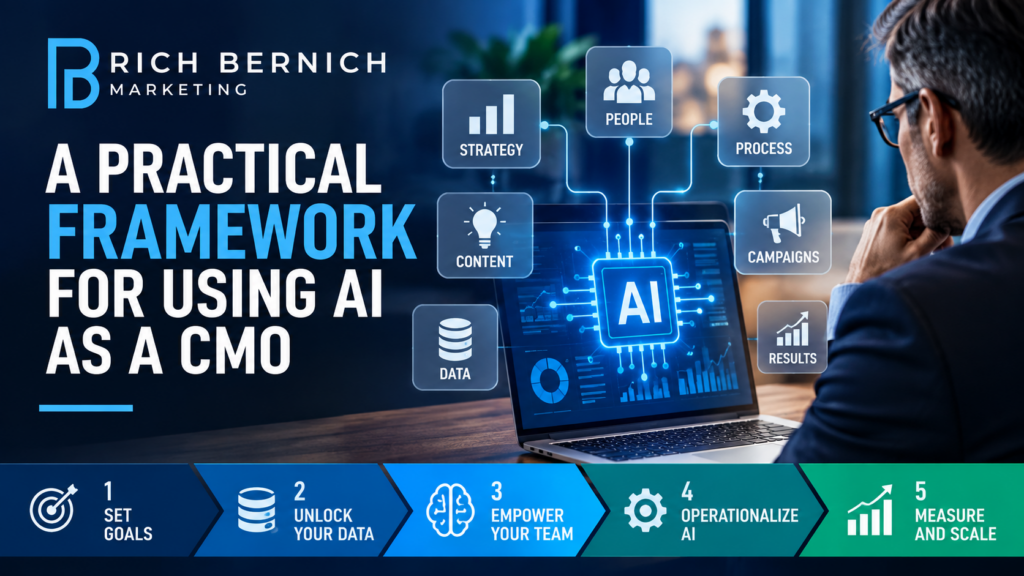
Every CMO I know has access to AI. Very few have a plan for it. The tools are cheap and everywhere; the hard part is deciding where AI actually earns its keep in a marketing organization and where it just adds noise.
Read more: A practical framework for using AI as a CMOAfter two decades running marketing for growth-stage and PE-backed companies, I’ve watched plenty of shiny technology come and go. AI is different in one important way: it touches almost every job on the team at once. That makes it powerful, and it makes it easy to spread effort so thin that nothing measurable changes.
This is the framework I use to keep it practical. It sorts AI work into four lanes, sets a few guardrails, and ties everything back to numbers a CEO or board already cares about.
Why most marketing AI efforts stall
Most AI programs in marketing don’t fail. They fizzle. A few people get very good with a chatbot, a couple of pilots launch, and six months later nobody can say what changed in pipeline, CAC, or retention.
In my experience, the causes are almost always the same:
- Tool-first thinking. The team buys a platform, then goes looking for a problem it can solve.
- No owner. AI is “everyone’s job,” which means it’s nobody’s priority when the quarter gets tight.
- Productivity without redeployment. Saving ten hours a week means nothing if those hours don’t go somewhere that moves a metric.
- Pilots that never graduate. Experiments run without a clear bar for success, so they never get killed or scaled.
- Trust gaps. One off-brand email or a made-up statistic in a sales deck, and leadership quietly pulls back.
A framework won’t fix all of that. But it does force the right question up front: what business outcome is this for, and how will we know?
Lane 1: Operate — do the work faster and cheaper
This is where almost everyone starts, and that’s fine. Operate is about taking cost and cycle time out of the work your team already does.
Good candidates include:
- First drafts of blog posts, emails, ad variations, and landing page copy
- Repurposing one asset into ten (a webinar into posts, clips, and a nurture sequence)
- Weekly performance summaries pulled from dashboards
- Creative briefs, meeting notes, and campaign QA checklists
- Localizing and personalizing content across locations or segments
The metric here is simple: cost per asset and time to launch. The discipline is harder. Decide in advance where the freed-up hours go. If AI saves your content team a day a week, that day should go to testing, distribution, or the strategic work that kept getting pushed. Otherwise the savings evaporate.
Lane 2: Understand — know the customer better than the competition does
This lane is underused and, I’d argue, the most valuable for most marketing teams. AI is remarkably good at reading large volumes of unstructured text that nobody has time to go through.
Point it at:
- Call center transcripts and chat logs
- Online reviews, yours and your competitors’
- Win/loss notes and sales call recordings
- Survey open-ends and support tickets
- Competitor websites, ads, and pricing pages
What comes back is the raw material for positioning: the exact words customers use, the objections that keep coming up, the reasons people churn. In home services, for example, reading a few thousand reviews will tell you more about what actually drives a five-star experience than any brand study.
Measure this lane by what it changes. Did a new insight produce a message test that won? Did it reshape an offer or a landing page? Insight that doesn’t reach the market is just an interesting report.
Lane 3: Decide — make better calls with the data you already have
Most marketing organizations are data-rich and decision-poor. The numbers exist; they just live in six systems and take an analyst two weeks to reconcile. AI can close that gap.
Useful applications:
- Budget scenario planning: what happens to leads and CAC if we shift 15% from paid search to paid social?
- Anomaly detection: flagging a spike in cost per lead or a drop in conversion before the monthly review
- Lead scoring and propensity models that sales actually trusts
- Faster, plainer-language answers to “why did this number move?”
A caution: AI is a strong analyst’s assistant, not a replacement for judgment. Treat model outputs as hypotheses to pressure-test, not answers to forward to the CFO. The win in this lane is speed and coverage. You look at more options, sooner, and make the call yourself.
The metric is marketing efficiency: blended CAC, pipeline per dollar, and how quickly budget moves toward what’s working.
Lane 4: Differentiate — build experiences customers can feel
The first three lanes make marketing better internally. This one changes what the customer sees. It’s the highest ceiling and the highest risk, which is why I put it last.
Examples:
- Conversational assistants that help a prospect pick the right plan or product
- Personalized onboarding and lifecycle journeys that adapt to behavior
- Interactive tools: quote estimators, guided comparisons, needs assessments
- Content and offers tailored to a customer’s situation, not just their segment
The test is whether a customer would notice, and care, if you turned it off. If the answer is no, it’s a feature, not a differentiator. Measure this lane with customer-facing metrics: conversion rate, time to value, retention, and NPS.
Only move here once the first three lanes are working. Customer-facing AI built on weak insight and loose guardrails is how brands end up in the news for the wrong reasons.
The guardrails
Speed without trust doesn’t last. These five rules keep AI work from creating problems faster than it solves them:
- A human owns every output that ships. AI drafts; a named person approves. No exceptions for customer-facing content.
- Brand voice is written down. If your voice lives only in people’s heads, AI will flatten it. Codify tone, banned phrases, and examples of good and bad copy.
- Claims get checked. Every statistic, testimonial, and product claim is verified against a source. Regulated industries need legal and compliance in the loop from day one.
- Data stays where it belongs. Know which tools can see customer data, and which can’t. Get IT and legal to sign off before anyone pastes a customer list into anything.
- Disclose where it matters. If a customer is talking to a bot, tell them.
Measuring whether it’s working
If you can’t show the impact in a board deck, it isn’t a program yet. Each lane gets its own scorecard, tied to a number leadership already tracks.
| Lane | The question it answers | Metrics to track |
|---|---|---|
| Operate | Are we doing more with the same team? | Cost per asset, time to launch, output per head |
| Understand | Do we know something competitors don’t? | Message tests won, insights shipped into campaigns |
| Decide | Is budget moving to what works, faster? | Blended CAC, pipeline per dollar, reallocation speed |
| Differentiate | Would customers miss it? | Conversion rate, retention, NPS, time to value |
Set a baseline before any pilot starts. A 90-day test with a clear success bar either graduates into standard practice or gets shut down. Both outcomes are wins; lingering pilots are not.
A 90-day starting plan
You don’t need a transformation office to start. You need an owner, a short list, and a deadline.
- Days 1–30: Audit and pick. Map where your team spends its hours and where decisions get stuck. Choose one use case per lane in Operate, Understand, and Decide. Name an owner for each and set the baseline.
- Days 31–60: Pilot and document. Run the three pilots. Write the guardrails down as you go: brand voice guide, approval flow, approved tools. Share early results with the team weekly.
- Days 61–90: Decide and scale. Graduate what hit the bar into standard workflows and job expectations. Kill what didn’t. Present results to leadership and propose one Differentiate project for the next quarter.
The point of the first 90 days isn’t to transform marketing. It’s to build credibility, so the bigger bets get funded.
The CMO’s real job with AI
AI won’t set your strategy, build your brand, or earn the trust of your CEO. That’s still the job. What it can do is give your team more time, sharper insight, and faster decisions, if you’re deliberate about where you point it.
Start with the business outcome. Pick your lane. Put guardrails in place. Measure what changes. The CMOs who treat AI as an operating discipline rather than a tool purchase are the ones who’ll have the results to show for it a year from now.
How is your team using AI today, and which lane is giving you the most return? I’d like to hear what’s working.