Speed-to-Lead with AI Agents
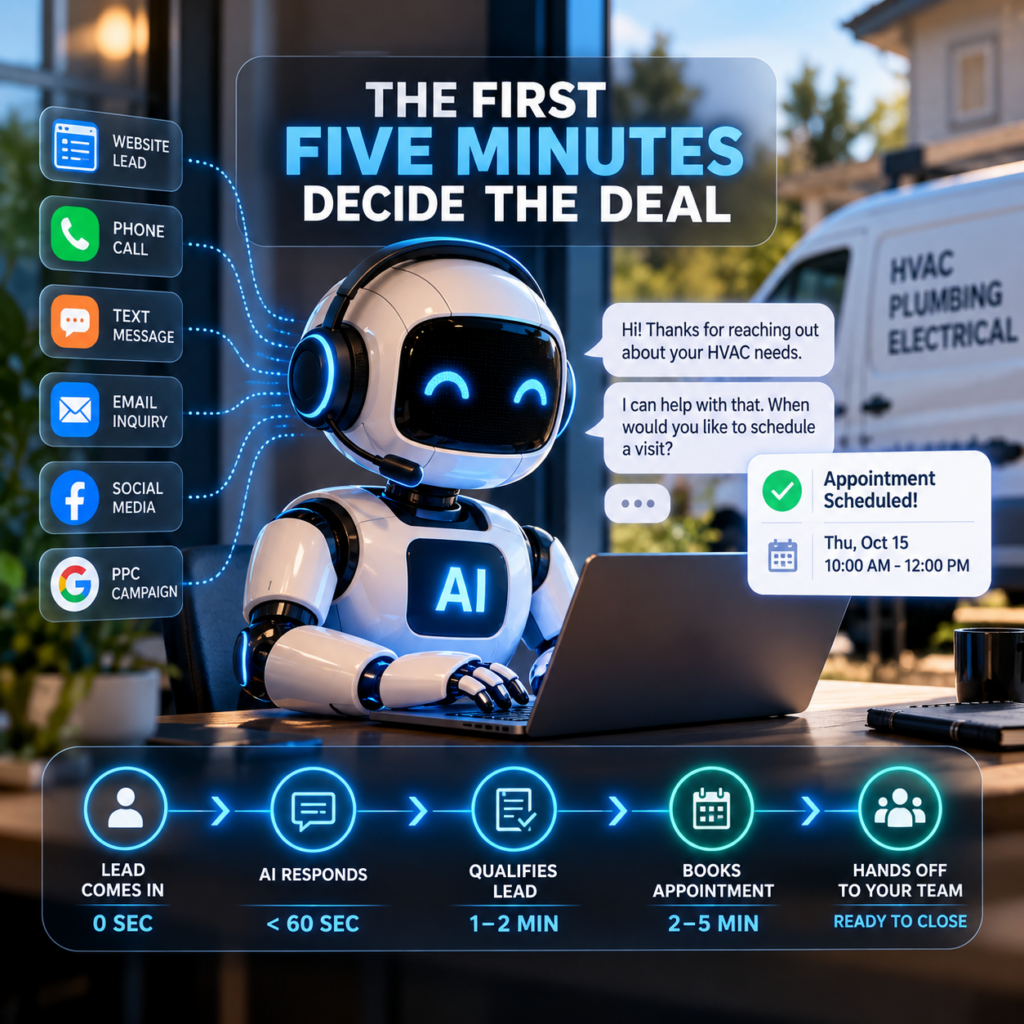
Introduction: The first five minutes decide the deal.
Every marketer knows the sting of a lead that went nowhere. The form was filled out, the budget was spent, and by the time someone called back the prospect had already booked with a competitor. In my experience running demand generation for multi-location service businesses, the single biggest leak in the funnel is rarely the ad or the landing page. It is the gap between the moment a lead raises a hand and the moment a real conversation starts.
The research on this has been consistent for more than a decade. Harvard Business Review’s well-known study, “The Short Life of Online Sales Leads,” found that companies contacting a lead within an hour were roughly seven times more likely to qualify it than those that waited even one hour longer, and the average response time across the firms studied was well over a day. Buyers have only become less patient since then. They submit three quotes at once, and whoever answers first frames the entire decision.
That is why speed-to-lead belongs on every CMO’s scorecard, right next to cost per lead and pipeline. The good news is that we no longer have to solve it by hiring more people to sit by the phone. AI agents can now answer, qualify, and schedule in seconds, at any hour, and hand our teams conversations that are already warm.
Why people alone can’t win the race
This is not a criticism of sales teams. Great reps are expensive, finite, and human. They sleep, take lunch, sit in meetings, and work through a queue one call at a time. Meanwhile, leads arrive in bursts: Monday mornings, the hour after a TV spot airs, a Saturday night when a water heater fails. No staffing model can flex instantly to that kind of demand without either leaving leads waiting or paying people to wait for leads.
Traditional automation helped, but only partly. An autoresponder email that says “thanks, someone will be in touch” technically counts as a response, yet it does nothing to move the buyer forward. The prospect still has a question, still wants a price range, and still wants to know when someone can actually show up. What closes the gap is not a faster acknowledgment. It is a faster conversation.
That is the shift AI agents make possible. Unlike a scripted chatbot, a modern agent can understand an open-ended message, look up information in your systems, take actions like booking a slot or updating the CRM, and decide when to bring in a human. In other words, it can do the first ten minutes of a rep’s job in the first ten seconds.
Seven AI agent ideas for speed-to-lead
The Instant Responder Agent. The simplest win is an agent that replies to every inbound lead by text and email within 60 seconds, in a natural, personalized voice. It references what the person asked for, answers the obvious first question, and invites a reply. The goal is not to close the sale. It is to start the conversation before a competitor does, and to turn a cold form fill into a two-way thread.
The Qualification Agent. Once the prospect replies, a second agent asks the three to five questions your best reps always ask: timeline, budget range, location, decision-maker, and the specific problem. It scores the answers against your ideal customer profile and writes the results straight into the CRM. Reps stop spending their first call on discovery basics and start it already knowing whether this is a hot opportunity or a nurture candidate.
The Booking Agent. For service businesses especially, the real conversion event is the appointment. A booking agent connects to your scheduling system, offers the prospect real open slots, handles rescheduling, and sends reminders. When the lead says “Can someone come Thursday?” the agent can actually answer yes and lock it in, which is the moment most leads are won or lost.
The After-Hours Voice Agent. Many high-intent leads still call. An AI voice agent can answer every call that rings after hours or overflows during peak times, capture the details, triage urgency, and either book the job or escalate a true emergency to an on-call person. Missed calls become booked calls, and the customer never hears a voicemail greeting.
The Smart Router Agent. Speed means little if the lead lands with the wrong person. A routing agent reads each lead’s location, service line, deal size, and language, then assigns it to the right rep or branch instantly, with a summary of the conversation so far. If the assigned rep doesn’t pick it up within a set window, the agent reassigns it automatically, so no lead ever sits unclaimed in a queue.
The Re-Engagement Agent. Not every lead converts on day one, and most CRMs are full of prospects who simply went quiet. A re-engagement agent works that backlog, checking in at sensible intervals with relevant, helpful messages instead of generic “just following up” emails. When someone replies, it hands the revived conversation back to the qualification and booking agents, turning old spend into new pipeline.
The Rep Copilot Agent. Finally, an internal agent sits beside your sales team. The moment a rep takes over a conversation, it delivers a one-paragraph brief: who the lead is, what they asked, what the AI already told them, and the recommended next step. After the call, it drafts the follow-up and logs the notes. This keeps the human handoff seamless, which is where many automated programs quietly break down.
How to roll it out without breaking trust
Start with one agent and one channel. For most teams, that means the Instant Responder on web form leads, because it is the easiest to measure. Track median time-to-first-response, contact rate, and appointment rate for a few weeks before launch, then compare. Once the numbers move, layer in qualification and booking. Trying to launch all seven agents at once is the fastest way to create a confusing customer experience and a skeptical sales team.
Be transparent and set guardrails. Customers are comfortable talking to AI when it is helpful and honest about what it is, and uncomfortable when it pretends to be a person or invents answers. Give your agents a clear scope, approved pricing language, and firm rules for when to escalate to a human. Make sure your texting and calling practices follow consent requirements like TCPA, and involve your legal team early rather than after launch.
Finally, bring sales into the design. The best agent programs I have seen were built with reps, not around them. When reps help write the qualification questions and see that the AI is handing them better-prepared prospects, adoption follows. Position the agents as the team’s first responders, not their replacements.
Conclusion: answer first, win more
Speed-to-lead has always been a competitive advantage. What has changed is that it no longer depends on how many people you can afford to keep by the phone. AI agents let any business, from a single-location contractor to a national brand, respond in seconds, qualify with consistency, and book while intent is at its peak.
The companies that treat this as a core growth lever, not a side experiment, will quietly take share from those still measuring response time in hours. If you are a marketing or sales leader, pull your current median response time this week. That one number will tell you how much revenue is waiting on the table, and which agent to build first.
What is your team’s speed-to-lead today? I’d love to hear how you are approaching it. Connect with me on LinkedIn or reach out through richbernich.com.