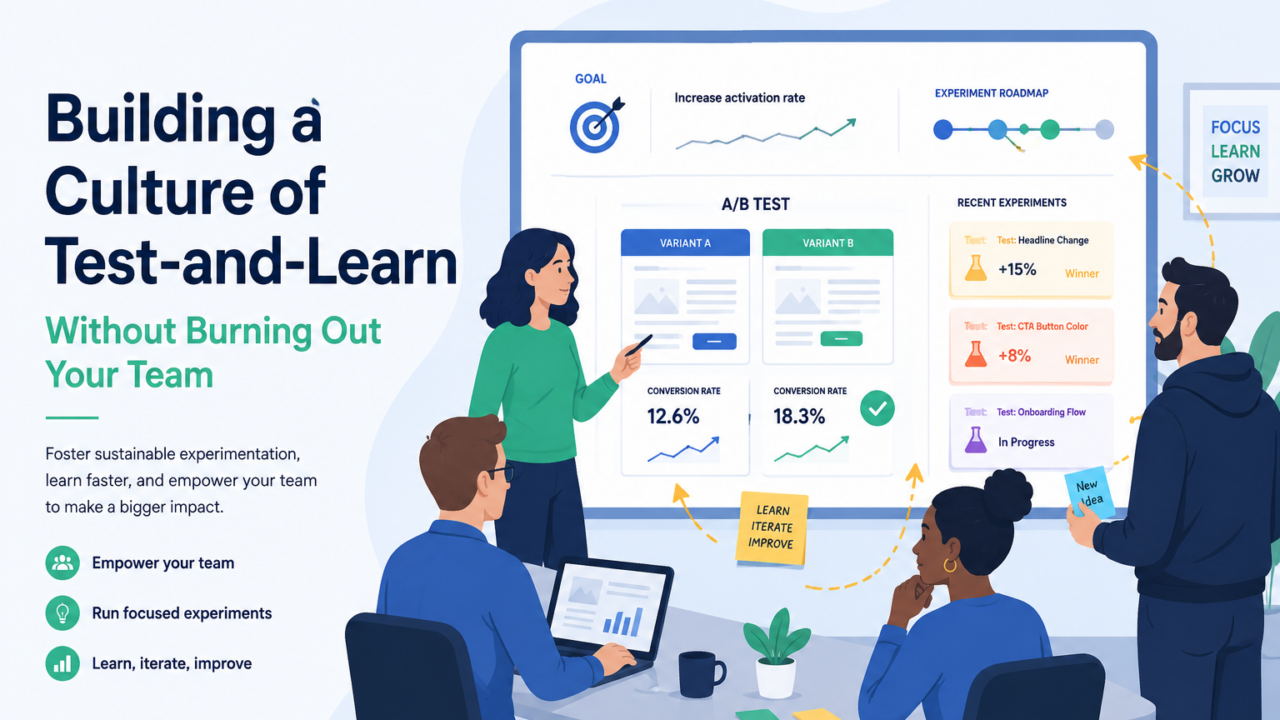
If you want modern growth, you need experiments—but if you want to keep your best people, you need boundaries. The leaders who win over the long term are the ones who build a test‑and‑learn culture that’s fast, focused, and sustainable, not frantic.
This post walks through a practical way to build that kind of culture: one where your team experiments aggressively, learns quickly, and still has the energy to do their best work quarter after quarter.
Why Test‑and‑Learn Cultures Burn People Out
On paper, “test‑and‑learn” sounds energizing. In practice, it often feels like:
- Endless A/B tests with no clear priorities
- “We should test this” becoming a catch‑all answer to every disagreement
- Slack messages at 9:30 p.m. asking for new variants “to hit the window”
- Weekly reports that show numbers, but not decisions or learning
The root causes usually look like this:
- No clear strategy, only tactics
- No agreed capacity limits for experiments
- No shared definition of a “good” test
- No consistent way to capture and socialize learning
When these gaps exist, a test‑and‑learn culture becomes a treadmill your team can’t step off. Your job as a leader is to provide clarity, guardrails, and rhythm.
Principle 1: Tie Every Test to a Strategic Question
The first safeguard against burnout is discipline around what you test.
Instead of:
“We need to run more tests this quarter.”
Try this:
“What 3–5 strategic questions do we need answered this quarter to hit our goals?”
Examples of strategic questions:
- “Can we profitably acquire more leads from Channel X?”
- “Can we move our average order value from $180 to $210?”
- “Can we reduce time‑to‑appointment from 5 days to 3 days?”
Once you have those questions, you can filter every proposed experiment:
- Does this test help answer one of our strategic questions?
- If not, is it worth displacing something that does?
This immediately reduces noise, protects your team from random executive requests, and ensures that tests feel meaningful, not arbitrary.
Principle 2: Limit Work in Progress (and Mean It)
Nothing drives burnout faster than “just one more test” layered on an already full plate. A healthy testing culture has explicit capacity constraints.
You might define limits like:
- No more than 3 concurrent tests per major channel (e.g., email, paid search, web)
- No more than 2 “complex” experiments at once (e.g., new journeys, pricing tests)
- No same‑week “emergency” tests unless they replace an existing one
Make these capacity limits visible:
- A shared experimentation board in your project management tool
- Columns for “Backlog,” “Ready,” “Running,” “Analysis,” and “Shipped”
- A clear “owner” for each experiment
Then—and this is key—protect these limits in leadership meetings. When a new idea appears, ask:
“What do we stop or delay to make room for this?”
This is where your test‑and‑learn culture becomes sustainable instead of extractive.
Principle 3: Design “Right‑Sized” Experiments
Teams burn out when every experiment is treated like a moonshot. Not every test deserves a full‑scale, cross‑functional production.
Create levels of experiments with clear expectations:
- Level 1: Quick checks
- Simple copy, headline, or creative swaps
- Owned by one person, minimal design/dev
- Turnaround: 1–3 days
- Level 2: Standard experiments
- New flows, sequences, or offer positioning
- Involve 2–3 functions (e.g., marketing + dev)
- Turnaround: 1–3 weeks
- Level 3: Strategic bets
- New pricing models, go‑to‑market motions, or product bundles
- Involve multiple teams and executive oversight
- Turnaround: 4–12 weeks
When you classify tests this way, you prevent small ideas from becoming big projects by accident. Your team knows what “good” looks like for each level, which reduces perfectionism and decision fatigue.
Principle 4: Standardize the Experiment Template
Context switching and ambiguity are quiet burnout multipliers. You can reduce both by giving your team a simple, standard template for every experiment.
For example, require each test to answer:
- Objective: What are we trying to learn or improve?
- Hypothesis: If we do X, we expect Y change in Z metric.
- Scope: Level 1, 2, or 3? Which channels and assets are involved?
- Success Criteria: What outcome will make us say, “This worked”?
- Run Time: How long will we run this to get a fair read?
- Owner: Who is accountable for execution and analysis?
This template should live in your existing tools—no extra bureaucracy. The payoff:
- Faster approvals
- Fewer back‑and‑forth clarifications
- Easier onboarding for new team members
- Better documentation of what you’ve tried and learned
Principle 5: Turn Learning Into Shared Assets
Nothing demotivates a team like feeling that their hard work disappeared into a report nobody read.
Make learning a first‑class citizen in your culture:
- Create a living “Playbook” or “Experiment Library” where each completed test gets:
- A short summary of what you tried
- The outcome (win, neutral, or loss)
- The key learning
- A recommendation (standard, avoid, revisit later)
- Build a recurring “Learning Review” meeting monthly or quarterly where the team shares:
- Top 3 wins, top 3 fails, and what changed as a result
- Patterns across channels or audiences
- Ideas to roll out globally
- Tie learning to recognition:
- Celebrate not only big wins, but also smart, well‑designed tests that disproved a bad idea and saved future time and budget
When people see that their experiments shape how the company operates, they feel energized rather than depleted.
Principle 6: Protect Recovery and Focus Time
A test‑and‑learn culture still needs deep work and recovery. You can’t think strategically if every hour is filled with execution.
A few practical guardrails:
- Block “No‑Test Fridays” (or an equivalent window) for analysis, planning, and deep work
- Set norms like:
- No new test launches after 4 p.m.
- No weekend launches unless it’s mission‑critical
- Encourage “focus sprints” where team members are offline from chat for 60–90 minutes to work on complex experiments
As a leader, model this behavior. When you respect boundaries, your team will believe you when you say you care about sustainable performance.
Principle 7: Align Incentives With Learning, Not Just Wins
If bonuses, recognition, and promotions are tied only to “winning tests,” your team will avoid risk—and carry stress when experiments underperform.
Instead, reward:
- Volume of qualified tests (that meet your template standards)
- Clarity and usefulness of documented learning
- Collaboration across teams to design and run meaningful experiments
- The ability to stop bad ideas quickly and redirect resources
Signal clearly:
“A well‑designed test that disproves a pet theory is just as valuable as a big win.”
This framing reduces anxiety and keeps experimentation intellectually honest.
How to Get Started in the Next 30 Days
You don’t need a full overhaul to move toward a healthy test‑and‑learn culture. Here’s a simple sequence:
Week 1–2:
- Define your strategic questions for the quarter
- Set initial capacity limits by channel and complexity level
Week 2–3:
- Roll out the standardized experiment template
- Classify current tests into Level 1, 2, or 3, and cut or downgrade where needed
Week 3–4:
- Launch your experiment library (even if it’s just a shared doc)
- Host your first “Learning Review” to socialize insights
From there, iterate on the process just like you iterate on your campaigns.
Closing: High Performance Without Heroics
A true test‑and‑learn culture isn’t about running more tests—it’s about running the right tests in a way your team can sustain.
When you connect experiments to strategy, set clear capacity limits, right‑size the work, and systematically capture learning, you create an environment where:
- Leadership gets better decisions and sharper insight
- The business gets compounding growth
- Your team gets to do their best thinking without burning out
That’s the kind of culture top performers want to be part of—and the kind of culture that makes marketing a true partner at the executive table.